KINO in Paris: Freedom, Connection, and the Moment the Night Refused to End
Paris did not wait for the lights to go down to understand that this night would matter. Long before KINO stepped onto the stage of La Bellevilloise, the room was already charged with something dense and restless, the kind of anticipation that comes from knowing you are about to witness a first. This was not just another stop on a tour itinerary. February 6, 2026 marked KINO’s first solo performance in France, and more broadly, his first solo tour across Europe. That weight was present everywhere: in the conversations exchanged in the queue, in the way people held their tickets, in the collective silence that fell each time the house lights flickered. Paris knew what it meant to be here, and KINO would soon prove that he did too.

La Bellevilloise, with its raw structure and intimate capacity, felt like a deliberate choice rather than a coincidence. It offered no distance, no safe space to hide behind scale or spectacle. The room demanded presence. As the final moments before the show stretched on, voices began to rise from the crowd, not in disorder but in unison. “Free Kino” echoed repeatedly through the speakers, layered with the chants coming directly from the audience, blurring the line between what was pre-recorded and what was instinctive. Before a single note was played, the concept of the tour had already taken physical form. This was not a slogan. It was a shared statement.
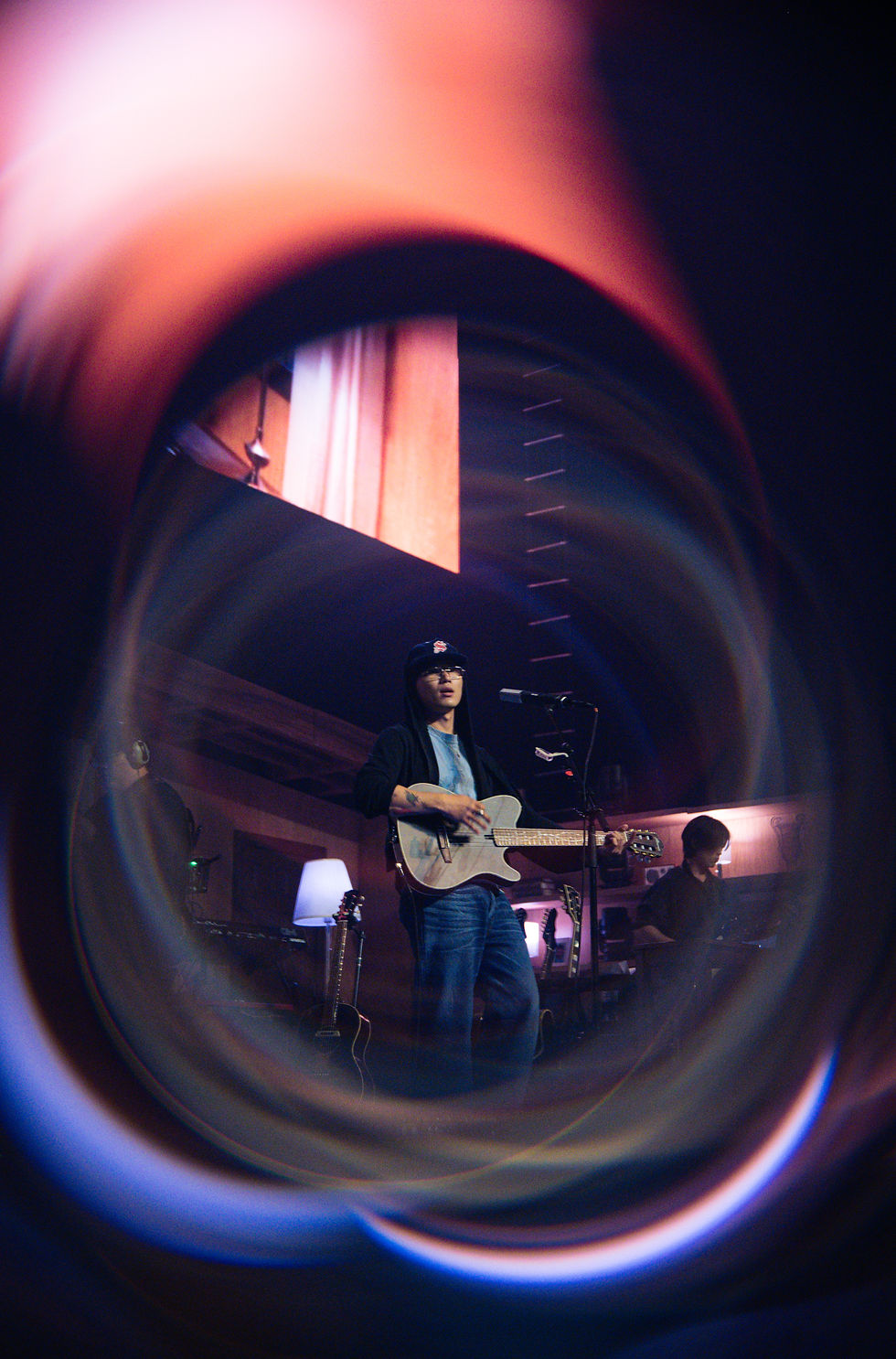
The entrance did not rush itself. Ambient sounds filled the venue as the musicians took their places, the drummer and guitarist stepping into the light first, grounding the space with their presence. When KINO finally appeared, dressed in a black suit and dark glasses, the reaction was immediate and overwhelming. He did not need to announce himself. The room reacted before he could. Almost as soon as he began, the glasses were gone, thrown aside with a gesture that felt symbolic rather than casual, as if removing a barrier between himself and the people in front of him. From that point forward, the concert unfolded not as a performance delivered at an audience, but as something built with them.
The opening stretch established a pattern that would define the entire night: call and response, exchange, recognition. The repeated “Free Kino” chants did not fade after the first songs. They returned, again and again, rising organically from the crowd and folding back into the show’s rhythm. KINO did not interrupt them. He followed them, allowing the audience to lead moments that could have easily been controlled from the stage. It was clear early on that this concert would be shaped as much by what came from the floor as by what came from the microphone.
Paris made itself known quickly. “Ici c’est…” KINO would begin, and the answer came instantly, loud and unwavering. “Paris”. The exchange repeated throughout the night, never losing its intensity. Between songs, KINO spoke often, switching naturally between English and French, choosing phrases that felt personal rather than rehearsed. He acknowledged the time it had taken to return, the distance, the wait. He spoke about nerves, about the pressure he had felt in the days leading up to this moment, and about the relief of seeing that energy reflected back at him in real time. Nothing about his presence suggested detachment. Every word landed because it was met halfway.

The atmosphere inside the venue remained electric, but it was never static. It shifted constantly, shaped by light, sound, and movement. Colors washed over the stage in waves (blue, red, white, yellow) each change reinforcing the emotional tone rather than distracting from it. The crowd moved as one, dancing, singing, responding not out of obligation but instinct. Water flew into the audience more than once, thrown from KINO’s bottle with playful abandon, a reminder that this was not a polished distance-driven production but a physical, shared experience.
Certain moments stood out not because they were louder, but because they revealed something deeper. After the third song, the crowd began chanting “Popopopop”, the rhythm picked up immediately by the drummer, transforming a spontaneous reaction into a collective pulse. It was one of many instances where the musicians became active participants in the audience’s energy rather than its anchors. That sense of collaboration extended throughout the night, especially during tracks that invited interaction rather than spectacle.
KINO’s relationship with the crowd felt unusually fluid. He asked questions, teased responses, challenged the room’s stamina. “Vous êtes fatigués?” he asked more than once, only to be met with firm refusal. Each time, he answered back with humor and admiration, acknowledging not just the noise but the commitment behind it. When he spoke about loss, about love, about freedom, those moments did not feel inserted for dramatic effect. They felt earned, grounded in the way the audience had already proven it was willing to stay present with him through quieter spaces as much as louder ones.

The emotional core of the concert revealed itself most clearly during the calmer passages. When the lights softened into blue and phones lit up the room, the atmosphere shifted from celebration to reflection. The venue seemed to breathe together. During these moments, KINO’s expressions said as much as his words. The way his eyes scanned the crowd, the way he lingered between lines, made it evident that this exchange mattered to him. The concept of freedom at the heart of the “FREE KINO” tour was no longer abstract. It existed here, in the permission to slow down, to feel without spectacle.
As the set progressed, confidence gave way to something closer to pride. During “Back In Time,” KINO turned repeatedly toward his musicians, sharing smiles that lasted just long enough to be noticed. These were not gestures for the crowd but acknowledgments of shared work, shared risk. He invited the audience to sing with him, then stepped back, letting their voices carry sections on their own. The result was not chaos, but cohesion. Paris did not overpower the moment; it held it. A brief instrumental break allowed for a change of atmosphere. When KINO returned, the visual language had shifted. The black suit was replaced by a brown leather jacket, black pants, and a T-shirt bearing the Union Jack, a look that leaned into rock influences without abandoning his own identity. The energy recalibrated instantly. This was not a reset, but a progression. The show did not start over; it evolved.
Interaction reached a new level during the dance-focused segment. When KINO invited the crowd to move with him, teaching choreography step by step, the stage hierarchy dissolved further. Even the musicians joined in, mirroring the movements during the explanation. The invitation felt genuine, not performative. When four fans were later brought on stage to dance alongside him, the moment carried no trace of spectacle for spectacle’s sake. Each interaction ended with warmth and respect, hugs exchanged before they returned to the floor. KINO spoke openly about the trust he feels toward his fans, questioning the need for heavy security when mutual respect was so clearly present.
As the night pushed forward, the energy did not dip. If anything, it intensified. Songs like “Solo” turned the venue into a single moving body, arms raised, voices unrestrained. The repeated chants of “Ici c’est Paris” intertwined with “Popopopop”, the drummer again locking into the rhythm, reinforcing the sense that the concert had become something co-authored. Gratitude surfaced repeatedly in KINO’s words, not as a closing sentiment but as a constant thread. He spoke about freedom not as an achievement but as a process, one that felt alive in that room.
Eventually, the show reached what felt like a conclusion. KINO took time to thank his team, his musicians, the staff supporting the European leg of the tour, and the fans who had filled the room with unwavering energy. Promises were exchanged, assurances of return spoken aloud and demanded back in response. When he left the stage and the lights cut out completely, the concert did not end. It transformed.
The darkness did not quiet the room. If anything, it sharpened it. “Free Kino” rose again, relentless, joined by the familiar rhythmic chants that had punctuated the night. There was no confusion, no hesitation. Everyone knew what came next, even if they did not know when. When the musicians returned first, the response was immediate. The encore was no afterthought. It was the emotional apex of the night.
KINO’s return to the stage during the encore carried a different weight. The formal structure had dissolved entirely. The performance felt looser, freer, yet more precise in its emotional intent. When “Shine” filled the room, the significance extended beyond nostalgia. As a song tied to his history with PENTAGON, it landed here not as a step backward but as an acknowledgment of the path that led him to this moment. Paris received it not as a throwback, but as part of the present narrative.

“Dirty Boy” followed, reinforcing the raw, unfiltered tone that defined the tour’s concept. The encore did not aim to outdo the main set in scale. It surpassed it in meaning. This was where the message of “FREE KINO” fully crystallized ; not in production, but in connection. KINO took time to acknowledge his musicians again, embracing them, standing hand in hand as they faced the crowd together. It was a simple image, but one that captured the essence of the night.
The final moments unfolded without urgency. The lights were raised so KINO could see the faces in front of him. He asked for the room to be illuminated, wanting to take in the people who had carried him through the night. Photos were taken, first alone, back turned to the audience, then together with his musicians by his side. These gestures did not feel staged. They felt necessary, like proof that this exchange had been real.
As “Club Sex Cigarettes” closed the night, it did not signal an ending so much as a release. KINO sang not to conclude, but to say goodbye properly. Promises of return were spoken again, this time quieter, steadier. When the final note faded and the stage emptied for the last time, the energy lingered, refusing to dissipate immediately.
Paris did not leave quickly. Conversations continued, voices hoarse, bodies exhausted but unwilling to let go. This was not just a successful tour stop. It was a confirmation. For KINO, the “FREE KINO” World Tour is not simply about stepping into independence. It is about building a space where freedom is practiced, shared, and sustained. In Paris, that space existed fully, from the first chant to the final encore. And for those who stood in that room, it will remain long after the lights have gone out.


Comments